
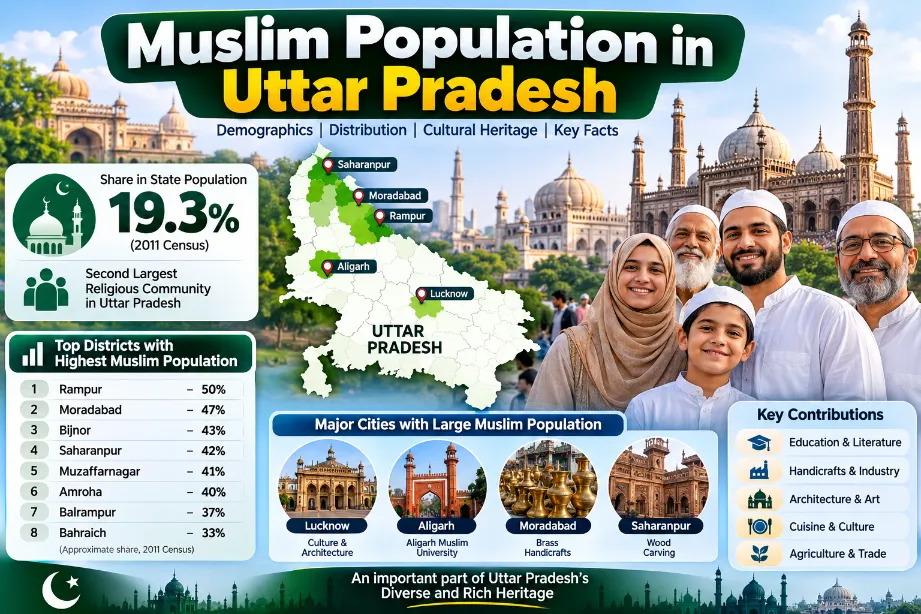
Uttar Pradesh (UP) is India’s most populous state and is home to people from diverse religious, linguistic, and cultural backgrounds. The Muslim Population in Uttar Pradesh forms one of the largest Muslim communities in India. According to the 2011 Census of India, Muslims account for approximately 19.3% of the state’s total population, making them the second-largest religious community after Hindus.
The Muslim community has contributed significantly to Uttar Pradesh’s history, culture, literature, architecture, education, handicrafts, and economy. Cities such as Lucknow, Aligarh, Moradabad, Saharanpur, and Rampur are well known for their rich Islamic heritage and cultural traditions.
Overview of Uttar Pradesh’s Population
Uttar Pradesh has a population exceeding 200 million according to the 2011 Census, and it remains India’s most populous state. The state’s demographic diversity reflects centuries of migration, trade, education, and cultural exchange.
Religious composition includes:
| Religion | Approximate Share (2011 Census) |
|---|---|
| Hindu | 79.7% |
| Muslim | 19.3% |
| Others (Sikh, Christian, Jain, Buddhist, etc.) | Around 1% |
These figures are based on the official Census of India conducted in 2011.
Historical Background
Islam has been present in Uttar Pradesh for many centuries. During the Delhi Sultanate and Mughal periods, many cities in the region became important administrative, educational, and cultural centers.
Historic cities including:
- Lucknow
- Agra
- Fatehpur Sikri
- Jaunpur
- Aligarh
continue to preserve monuments, mosques, educational institutions, and cultural traditions that reflect this historical legacy.
The Nawabs of Awadh also played an important role in developing Lucknow as a center of art, poetry, music, cuisine, and architecture.
Districts with Higher Muslim Population
The Muslim population is not evenly distributed throughout Uttar Pradesh. Some districts have significantly higher percentages than others.
Examples include:
| District | Approximate Muslim Share (2011) |
|---|---|
| Rampur | Around 50% |
| Moradabad | Around 47% |
| Amroha | Around 40% |
| Saharanpur | Around 42% |
| Bijnor | Around 43% |
| Balrampur | Around 37% |
| Bahraich | Around 33% |
| Muzaffarnagar | Around 41% |
These figures are approximate and derived from official census data.
Major Cities with Significant Muslim Communities
Several urban centers have substantial Muslim populations that contribute to local commerce, education, and cultural life.
Lucknow
Lucknow is renowned for:
- Islamic architecture
- Urdu literature
- Traditional cuisine
- Chikankari embroidery
- Religious and educational institutions
Aligarh
Aligarh is internationally recognized because of Aligarh Muslim University (AMU), one of India’s leading higher education institutions.
Moradabad
Often called the “Brass City of India,” Moradabad has a large Muslim artisan community involved in brass handicrafts exported worldwide.
Saharanpur
Saharanpur is famous for:
- Wood carving
- Furniture manufacturing
- Religious institutions
- Traditional craftsmanship
Educational Contributions
Muslims in Uttar Pradesh have established numerous educational institutions ranging from schools and madrasas to universities.
Some notable institutions include:
- Aligarh Muslim University
- Nadwatul Ulama, Lucknow
- Darul Uloom Deoband (located in neighboring Uttar Pradesh district of Saharanpur)
These institutions have educated students from across India and abroad.
Economic Contributions
The Muslim community contributes to several sectors of Uttar Pradesh’s economy.
Major industries include:
- Brass handicrafts
- Leather products
- Textile manufacturing
- Carpet weaving
- Hand embroidery
- Agriculture
- Small and medium enterprises
- Retail businesses
Cities such as Moradabad, Bhadohi, Meerut, and Lucknow are globally recognized for products manufactured by skilled artisans.
Cultural Heritage
The cultural identity of Uttar Pradesh has been shaped by contributions from multiple communities.
Muslim traditions have influenced:
- Urdu poetry
- Classical music
- Architecture
- Cuisine
- Calligraphy
- Handicrafts
- Festivals
- Literature
Popular dishes like kebabs, biryani, and traditional sweets from Lucknow have become part of India’s culinary heritage.
Languages Spoken
Most Muslims in Uttar Pradesh speak:
- Hindi
- Urdu
Regional dialects such as Awadhi, Bhojpuri, Braj, and Rohilkhandi are also commonly spoken depending on the area.
Rural and Urban Distribution
The Muslim population is present in both rural and urban areas.
Urban communities are often involved in:
- Manufacturing
- Trade
- Education
- Professional services
Rural populations commonly participate in:
- Agriculture
- Animal husbandry
- Local businesses
- Cottage industries
Demographic Trends
Population changes over time are influenced by many factors, including:
- Birth rates
- Urbanization
- Education
- Healthcare access
- Migration
- Economic opportunities
Since the most recent official nationwide religion-wise census remains the 2011 Census, any newer estimates should be interpreted cautiously until updated official census data are released.
Government Welfare and Development
Like other residents of Uttar Pradesh, Muslims may benefit from government welfare and development programs based on eligibility criteria rather than religion alone. These may include initiatives related to:
- Education
- Healthcare
- Housing
- Skill development
- Employment
- Financial inclusion
Access depends on the specific requirements of each scheme.
The Muslim Population in Uttar Pradesh represents an important part of the state’s demographic, cultural, and economic landscape. With a long history spanning centuries, Muslim communities have made lasting contributions to education, architecture, literature, traditional crafts, commerce, and cultural heritage. Understanding the distribution and role of different communities helps provide a more complete picture of Uttar Pradesh’s diverse society. Official census data remain the most reliable source for demographic information, and future census releases will provide updated insights into population trends.
What is the Muslim population percentage in Uttar Pradesh?
According to the 2011 Census of India, Muslims constitute approximately 19.3% of Uttar Pradesh’s total population.
Which district has the highest Muslim population in Uttar Pradesh?
Rampur is among the districts with the highest proportion of Muslims, with approximately half of its population identifying as Muslim according to the 2011 Census.
Which cities have large Muslim communities?
Major cities include:
- Lucknow
- Aligarh
- Moradabad
- Saharanpur
- Rampur
- Meerut
Which language is commonly spoken by Muslims in Uttar Pradesh?
Hindi and Urdu are the most commonly spoken languages, along with several regional dialects.
Are Muslims active in traditional industries?
Yes. Muslim communities have long contributed to brassware, leather goods, textiles, carpets, embroidery, woodworking, and other artisan industries across Uttar Pradesh.

- EducationTrove com: A Guide to Its Learning Resources and Educational Content - August 8, 2026
- Uttar Pradesh GST Code - August 7, 2026
- How the NSFAS Login Portal Helps You Manage Your Funding - August 5, 2026
